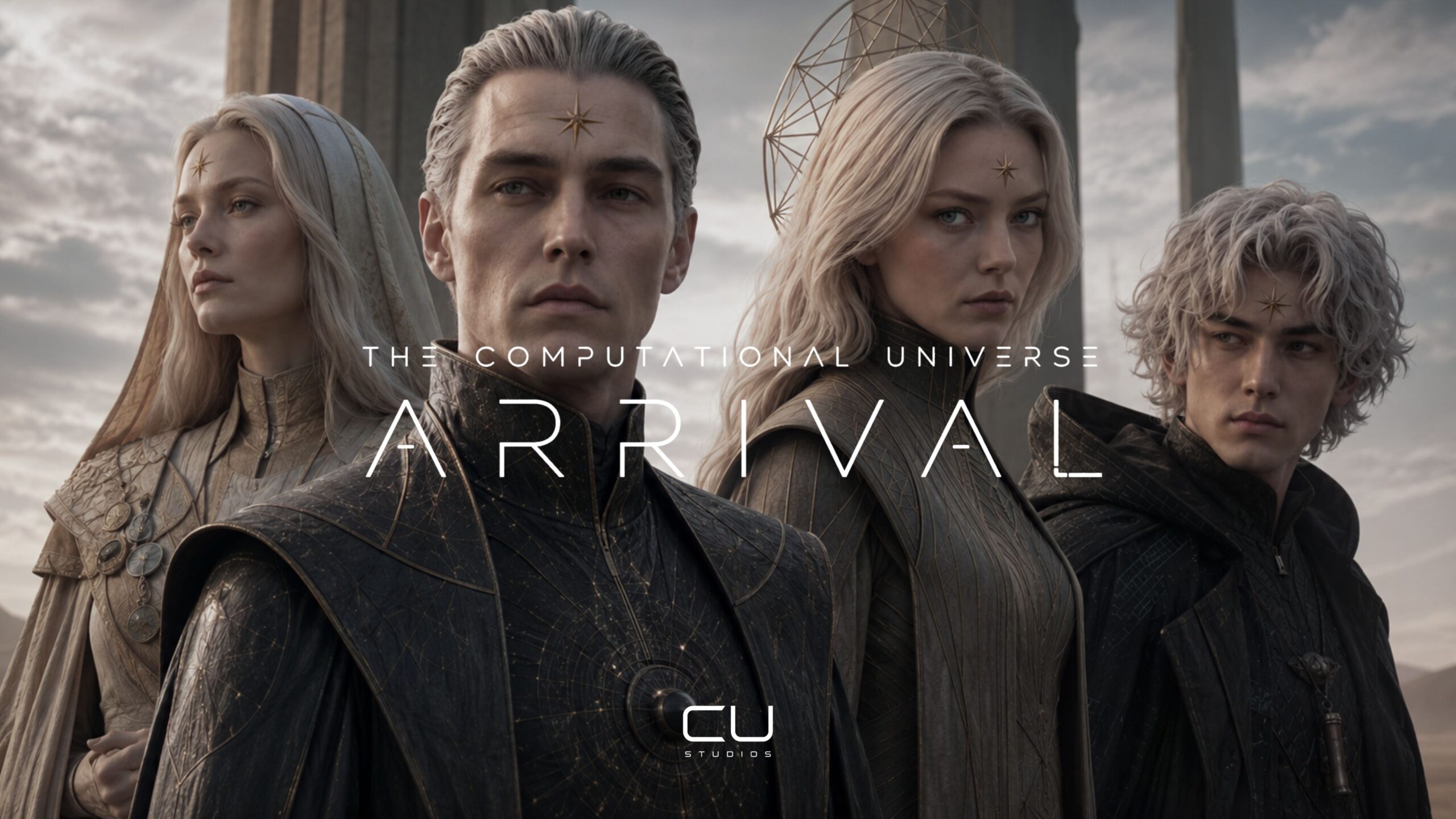
In June 2026, CU Studios was officially founded, and we began developing our first independent game, The Computational Universe: Arrival.
It is a strategy-driven narrative card game in which players take the role of the Zhilue civilization. You descend upon less advanced civilizations and reshape their destinies.
You will play as one of four Reformers, each representing a different philosophy and playstyle:Raph the Protector represents order, tyranny, and sacrifice.
Vasa the Harvester represents mathematics, truth, and reason.
Opna the Regressor represents compassion, regression, and faith.
Xom the Experimenter represents absurdity, deconstruction, and reconstruction.
Throughout the game, you will face difficult moral choices, hard science-fiction stories, and epic transformations of entire civilizations. Exploring the minds of the four Reformers and witnessing the struggles of the civilizations beneath them will create a powerful and unprecedented experience.
When you play as Raph and watch your subjects become slaves through their own ignorance, you are both a tyrant and a loving father.
When you play as Vasa, the tungsten-steel icosahedron in your hand cuts into your palm, yet you can hear the fugue of the universe. You stand alone among the stars.
When you play as Opna, you try to help others as the last conscience of the Computational Universe, yet your love is never returned. Through her struggle, you will witness the true cost of compassion.
When you play as Xom, you discover the source code beneath a world that is gradually losing all meaning. You mock the other Reformers through absurdity and deconstruction—even though Raph, Vasa, and Opna are also your friends.
This story, this experience of reshaping civilizations, and this journey through the soul will make you question who you truly are.
Stories in the Computational Universe have always been filled with struggle and philosophy. Through dramatic events, they explore extraordinary forms of suffering.
“In Raph, I saw divinity,” said the first devoted fan of The Computational Universe: Arrival.
This will be an unmistakably Computational Universe adventure.
What can you expect when entering this universe?
First, our stories have never been written for everyone. They are not generic products made only for commercial appeal. They are written for dedicated players like you.
We will never abandon high-concept science fiction just to follow the market. We believe serious science-fiction fans are our true core players.
When designing The Computational Universe: Arrival, we drew inspiration from games like Cultist Simulator and Stellaris. Through fragmented yet deeply connected storytelling, we want players to feel the Computational Universe is a real and immense place.
The Computational Universe is not cyberpunk. Its central idea is that the universe itself is a vast computer, inspired by the scientific theory of the computational universe. Instead of conventional physics-based science fiction, the game explores unique possibilities of computer science fiction.
Philosophy is another essential part of the Computational Universe.
I graduated from New York University with a degree in philosophy and have a deep interest in ancient Greek thought. When I write stories for the Computational Universe, almost every major character becomes a philosopher.
Raph was inspired by Niccolò Machiavelli and Marcus Aurelius. Vasa was inspired by Hypatia. Opna was inspired by Jean-Jacques Rousseau. Xom was inspired by the archetype of the Jester and by Lorenzo de’ Medici.
This is a story about the darkness before the Renaissance—and the first light that eventually emerges from it.
A month and a half has passed since development began. During this time, we have completed the main story structure and developed the game’s core design in greater depth.
We describe The Computational Universe: Arrival as a strategy-driven narrative card game. Strategy comes first, and narrative follows, reflecting the game’s primary focus. Players will first experience deckbuilding and a wide range of strategic systems. Beyond that, the game is planned to contain a narrative of approximately one million words.
Strategy and narrative will constantly affect each other. We may not recreate the endless “one more turn” feeling of Civilization, but we believe players will find it equally hard to stop once they begin reshaping a living civilization.
Development is now moving toward our first milestone: the concept demo.
We will first refine and stabilize the game’s design, complete the user interface, and develop the first playable module. Once ready, we will reveal our first trailer and introduce the game to everyone.
Follow CU Studios.
Follow The Computational Universe: Arrival.